
A new module was developed in SNES which embedded continuous reflection in taught sessions and through a reflective essay assessment.
Our opportunity
In 2021, the School of Natural and Environmental Sciences embarked on a redesign of their Stage 1 curriculum involving over 180 students from eight degree programmes across agriculture, animal and environmental science and food and land management. This followed a curriculum review which identified a need for students to be exposed to sustainability content and active learning approaches but also emphasised the importance of embedding key employability skills and reflective practice at an earlier stage in the undergraduate learning journey. ‘Sustainability in Practice’ (NES1100) was one of the modules developed in response. It focuses on interdisciplinary problem-based learning to explore key sustainability challenges and has skills development and reflective practice integrated into taught sessions and assessment.
Our solution (approach)
With its focus on interdisciplinary problem-based learning, ‘Sustainability in Practice’ is delivered through weekly 2-hour seminar sessions where students work in mixed discipline groups to tackle real-world sustainability challenges. In each seminar, students engage in tasks and activities designed to help them develop key skills and competencies including critical thinking, collaboration and teamwork, problem-solving, data synthesis and research, communication and digital skills. Reflection is an integral part of the problem-based learning pedagogy, encouraging learners to make connections between their experiences, the problem-solving process and outcomes. As such, each seminar was designed to include embedded time for reflection. A bespoke ‘Sustainability in Practice’ reflective practice template was developed in NU Reflect for students to complete at the end of each seminar session. This used the STARR model (Situation, Tasks, Action, Result, Reflection). Canvas resources were also developed in conjunction with LTDS content developers to support students in this process.
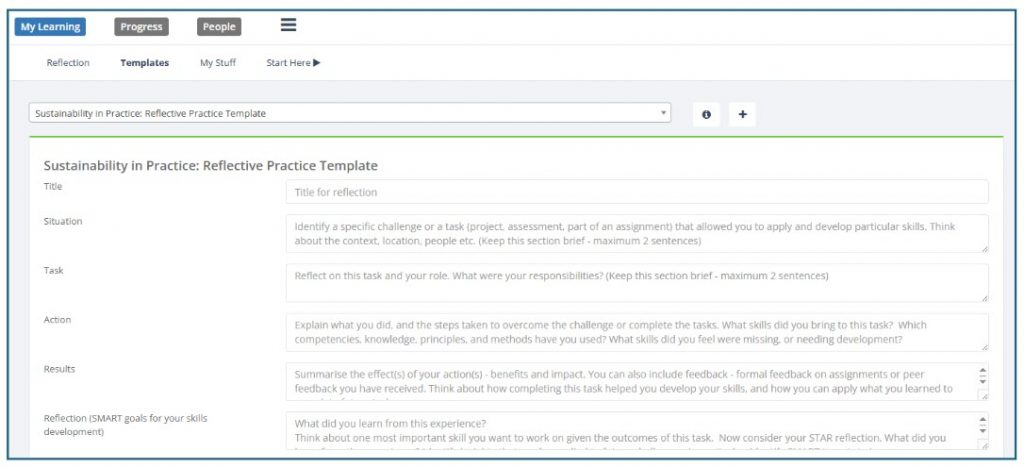
NU Reflect: Sustainability in Practice Reflective Practice Template
The continuous reflection embedded into each taught session encourages students to build a repository of reflections in NUReflect. This serves as an important resource for the end of module assessment, which is a 500-word reflective essay, where students have to critically reflect on two different skills (from a list of 10) which they have developed over the course of the module. A marking rubric was designed to focus on three key elements: relevance and completeness of reflections; clarity and presentation; and critical analysis.
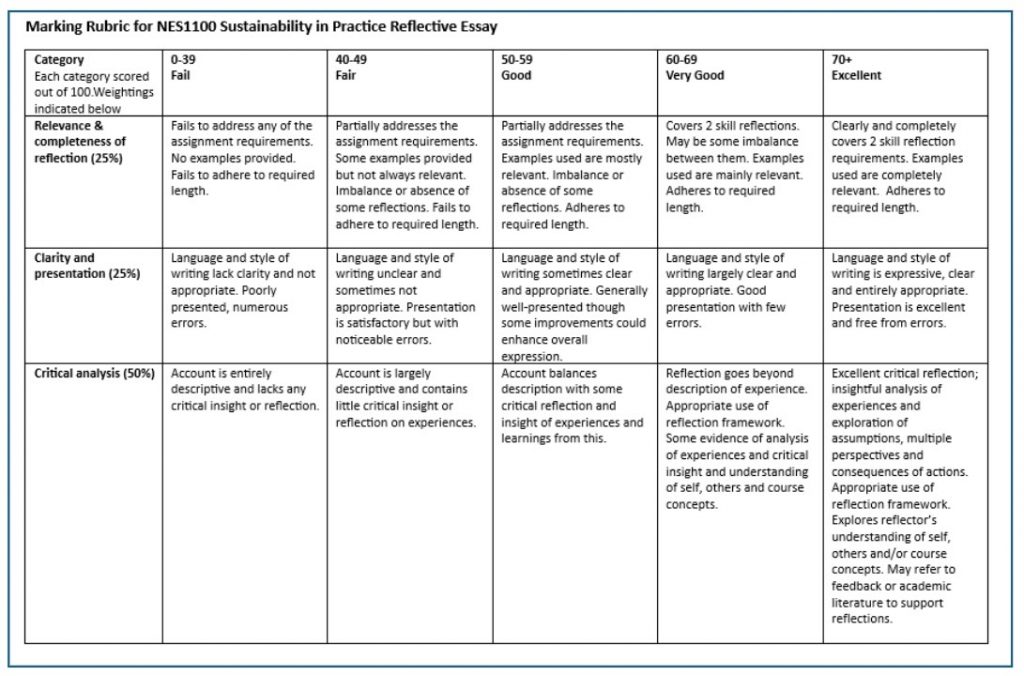
Marking Rubric for Reflective Essay Assessment
The impact (results)
Embedding time for reflection in each seminar session and using this as a foundation for the reflective essay assessment, enabled students to:
- Become familiar with the NUReflect portal and reflective frameworks at the beginning of their learning journey here at Newcastle
- Begin to develop higher order critical thinking skills, reflecting on experiences and the learning drawn from this including what worked well/less well and strategies for adapting in the future
- Begin to develop their skills in reflective writing (this is more personal and less formal than traditional academic writing but should still be professional, critical, reasoned and evidenced).
- Build a repository of skill reflections in NUReflect which can be used as examples in future employment applications/interviews
Lessons learned
In some disciplines such as teaching and clinical practice, reflective practice is common however for other disciplines (including those in SNES), reflection and a more reflective style of writing is less familiar. Many students initially struggled to adapt to thinking and writing in this way. We found it helpful to provide examples of reflective writing and interrogate these with students. Bespoke step-by-step guides and videos were developed for Canvas on how to use NU Reflect including how to record and tag reflections. Signposting to additional resources such as the Reflective Writing Style Guide and Reflective Practice module on the Academic Skills Kit website helped students looking for further support.
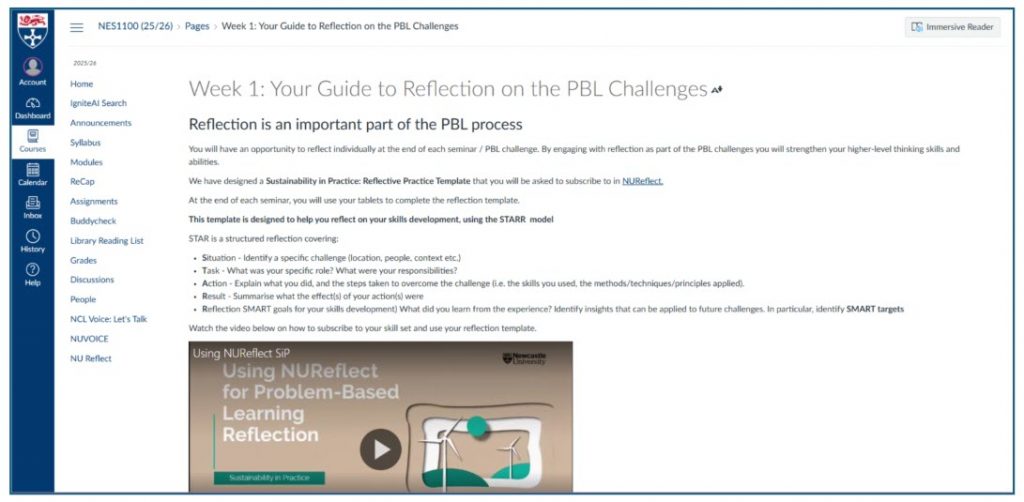
Canvas Resources to support students with reflective writing
In introductory lectures for the module, we found it useful to communicate to students the wider importance of engaging in reflective practice and writing, noting in particular the value of being able to reflect critically on skills developed and strategies employed to overcome challenges as examples for future job applications and interviews.
As this was a Stage 1 module, we found that students needed support with logging into NU Reflect and subscribing to reflective practice templates. Seminar facilitators were allocated time to trouble shoot problems and support students through this process.
Tips for colleagues
One way to encourage students to engage in continuous reflective practice and complete reflections (whilst still fresh) was found to be by embedding dedicated time within taught sessions for this activity. Students were provided with suggestions for skills or competencies developed in each seminar session to provide accessible entry points into the reflection process.
Due to the large cohort and frequency of seminars in this module, it was not considered feasible to monitor student engagement with the reflective templates in NU Reflect. The summative reflective essay was introduced as a way of formally assessing students’ engagement with reflection. With smaller cohorts, reflections recorded in NU Reflect could be viewed by staff and continuous/formative feedback provided to learners or used as contributions to a summative assessment.
Skills and attributes
Students were able to develop the following attributes:
Education for Life Strategy
This case study reflects the following aims of the Education for Life strategy:
- Fit for the future: To ensure our students are fit for their future, our teaching is fit for the future of our offer, and our colleagues are fit for the future of HE
Further resources
Short reflective writing style guide Academic Skills Kit
Authors
 |
Dr Amy Proctor Senior Lecturer School of Natural and Environmental Sciences |
Thanks for sharing Amy, this looks really useful. We can embed this reflective practice throughout other stages of the degree.