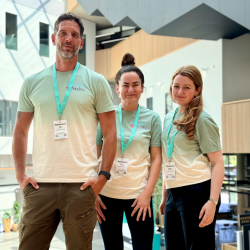
Real-world enterprise challenges in Psychology

Dr Patrick RosenKranz discusses how the School of Psychology designed enterprise challenges with charities to help students apply psychological literacy to real community issues, develop employability skills, and see how their subject knowledge can make a difference beyond professional psychology careers.

Embedding overseas research mobility into the curriculum

Dr Carys Watts explains how embedding short overseas research projects into the curriculum gives bioscience students a structured, supported and equitable way to experience international research without committing to a full semester or year abroad.

Building students’ confidence and capability in oral communication

How Tariq Shafi, Senior Pre-Clinical Lecturer at NuMed Malaysia, supports Stage 1 Medicine students to develop oral communication skills through a staged research communication task. The approach combines formative preparation, small-group presentation, peer questions and immediate feedback to help students build confidence and capability in a supportive environment Our challenge  Oral communication is an important part of students’ Read more about Building students’ confidence and capability in oral communication[…]

Picture of a gloved hand holding a test tube with blue liquid inside in a laboratory setting.

Communicating to succeed: enhancing Bioscience students’ skills through science communication

Discover how a flexible, adaptable 3-week summer project focusing on science communication can enhance bioscience students’ academic and professional skill gains, placement attainment rates, confidence, as well as provide a transnational educational opportunity.

Dr Alessio Iannetti (FMS)

Enhancing support for international students in Faculty of Medical Sciences

Dr Alessio Iannetti (FMS) explored how best to support international students—while comparing their needs to those of home students. Guided by student and colleagues feedback, his pilot project suggests practical ways to strengthen support and foster inclusive learning communities.

Dr Alessio Iannetti

“Who wants to be millionaire” as a game to enhance students’ engagement and teamwork skills in life sciences curricula

Does the competitive nature of a game help to improve student knowledge retention, while making a seminar session more fun and engaging? Dr Alessio Iannetti investigated this and shares the results in this case study.

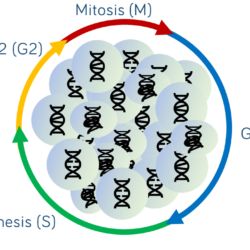
An image of the new materials showing a visual representation of the cell cycle, with coloured connecting arrows labelled with the different parts of the cycle with images of the cells contained with the circle.

Giving new life to an old presentation: A Module Revamp Case Study

Emily Smith, LET Coordinator in FMS TEL, describes how she worked with Sue Campbell and Krissie Howkins from the Chemotherapy Nurse Training module team, responding to negative student feedback to review and revamp materials for an unpopular topic in the module, replacing text heavy resources with animated infographics, and interactive quizzes using H5P, turning the topic into one of the most popular of the module.

An image of the title image of one of the Newcastle University Team's Induction Period Challenge presentation. It shows a group of people holding planet Earth in their hands, while other people hold, a light bulb, a solar panel and someone kneeling down gardening. There are wind turbines in the background.

Incorporating the Peer Mentoring Induction Period Challenge on United Nations Sustainable Development Goals into Teaching

Dr Helen Mason and Gabrielle Vallons explain how the Peer Mentor Induction Period Challenge on the UN’s Sustainable Development Goals is incorporated into first year teaching and delivered to students studying Nutrition and Dietetics, creating opportunities for students to submit group proposals for creative and innovative solutions to campus related issues with the potential to have lasting impact across the student body, alongside enhancing Peer Mentors’ personal and professional development.