
Creating inclusive groups and supporting collaboration in Civil Engineering.
My challenge
Collaboration and teamwork are essential attributes for professional Civil Engineers who need to be able to work together to develop efficient solutions to complex problems.
In my subject area, Geospatial Engineering/surveying, it’s often not possible to work alone and therefore group work makes up a large proportion of the module activity and assessment in my modules. In designing group work in my Stage 2 and Stage 3 modules I wanted to ensure that these were inclusive and fair.
My Approach
Forming groups
Typically, I form student groups of between 3-6 students, with 5 being an ideal number. When forming larger groups, I consider students’ academic profile, the mix of international/home, male/female students and if possible work experience (such as summer placements or Year in Industry).
We rank students according to their academic profile and use this to ensure that each group contains a mix of abilities. I then adjust the groups so that we don’t have say, 1 female student working with 5 male students. For our stage 3 field course I also ask if students have been on work placements and use this as extra information when I form groups. Other staff, such as the technician who know the students well, are also asked for input. This can be very valuable as some staff know their characters well but sometimes also friendships or other pastoral reasons for group formations.
Planning groups takes time, but it is worthwhile, particularly when the group work assessment contributes 70% of the module marks. For large cohorts in advanced Stages and when the activity is either formative or less than 30% of the modules, I have allowed students to choose their team-mates.
If I have students with additional needs affecting their ability to work in groups, I have a conversation with them to find out how to best to support them. For example, I can put them together with at least one friend they are comfortable working with.
Practicalities
Where work is conducted on campus, I timetable practical sessions for students to work together. This reduces the need for groups to negotiate times to meet and also ensures that we can be present for advice, to give informal feedback and oversee attendance. Generally, if they attend these practical sessions they will finish the assigned work, leaving only the writeup to finalise. Obviously, groups can meet outside of timetabled sessions as needed.
I give students guidance on working in groups and direct them to notify me if they cannot resolve issues. I also give technical instructions on how to how to create a Microsoft365 file space using Teams. All group meetings should to be recorded in a logbook, detailing actions and outcomes. I also offer drop-in sessions for groups that require support. We don’t explicitly give people specific roles in groups – they negotiate these themselves.
Adjusting group marks
Alongside group submissions, I require students to complete a peer assessment. This is a simple form they fill in to rate the contribution of their team mates on a 5 point scale ranging from “no contribution” to “excellent contribution”. The form asks students to give comments justifying their rating.
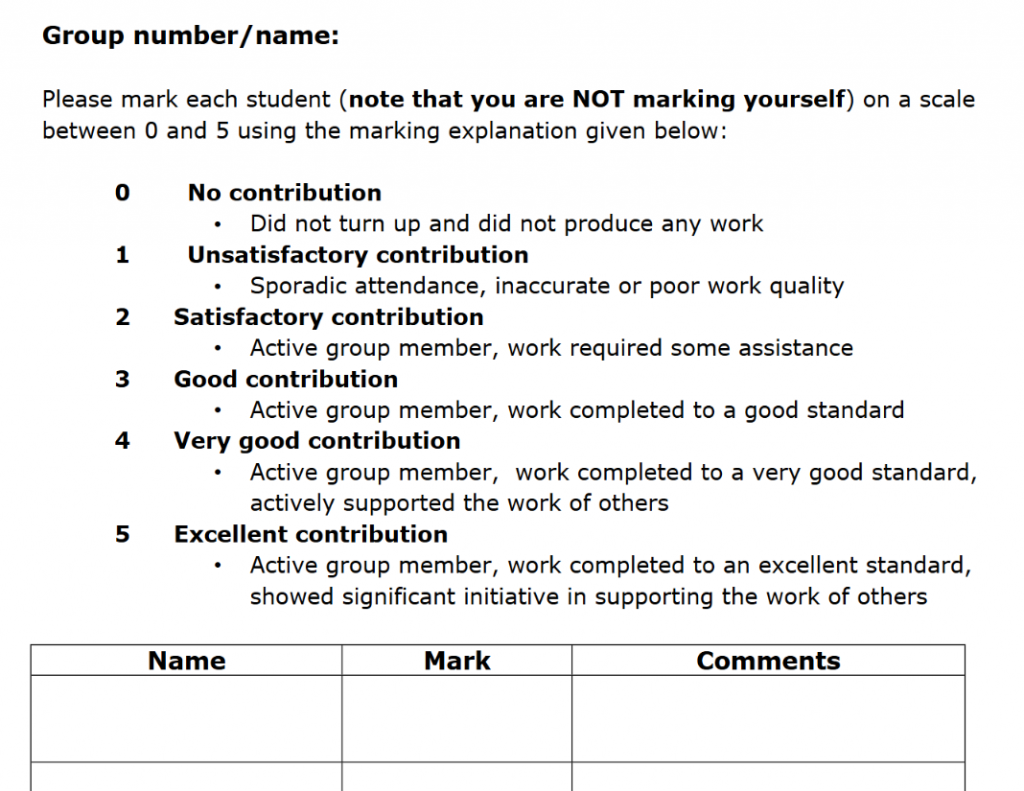
Figure 1: The Peer Assessment Form
I feed the student evaluation scores into a spreadsheet we use in Engineering to generate an adjustment factor. (You can read about our method in Full article: A robust approach for mapping group marks to individual marks using peer assessment)
After marking the group submissions, we calculate individual marks based on the group mark, the peer review and their attendance. The proportions differ slightly from module to module, but as an example for Spatial Data Engineering and BIM (CEG2723) this is calculated as:
| Individual mark = | (Group mark * 30%) + (Group mark * peer assessment adjustment factor *35%) + (group mark * attendance *35%) |
If there is little variance in the peer assessments, the adjustment factor for individual members will be close to 1. Similarly, if the group has consistent attendance this will result in an attendance score of 1. In these circumstances the individual marks will be only a few points around the group mark. However, if a group contains a member who has made minimal contributions and failed to attend, their individual mark will be significantly lower. On occasions this could mean a high range of marks given to individuals in the same team (eg from 35-70).
It’s important to note that we review these peer assessments and comments carefully and look out for evidence of bullying or unfair treatment. If this arises, we can revisit group logs and speak with the team.
I added the attendance element to the assessment in recent years, but manage this flexibly. Clearly, things crop up for students that can affect their attendance. They don’t get marked down if they notify their group in advance, or if there are genuine reasons for not attending or they have a PEC. My goal here is to foster professionalism and accountability.
On my modules I include an individual element alongside the group work. For CEG2723 this is a lab report with a 35% credit weighting, for the residential field course CEG3702 students write an individual reflection with a 30% weighting.
The impact (results)
Although teamworking is not an explicit learning outcome for my modules, we see that students develop essential communication, negotiation and organisational skills through collaborative activities.
Students understand that the process we use to adjust group marks is fair. The value we give to attendance supports collaborative responsibility and team accountability and reliability. We have been using this approach for over 10 years without difficulties and I believe it helps with student engagement.
We find that group working, particularly on field trips, helps the cohort to gel. We hear students say things like: “now I can go to lectures and sit next to anybody”.
Tips for colleagues
- For larger projects invest time engineering the groups – this is the most inclusive way to form the groups and it reduces the need to make interventions later.
- Be prepared to make occasional interventions when groups genuinely aren’t functioning
- Be clear from the outset that you will scale marks based on peer-assessment and attendance.
- Ensure that students justify their peer marks and be vigilant for any unfair treatment
Skills and attributes
Students were able to develop the following attributes:
- Reflective and self-aware
- Self-management
- Flexibility and resilience
- Critical thinking
- Problem solving
- Creative thinking
- Communication
- Collaboration
- Leading and influencing
Education for Life Strategy
This case study reflects the following aims of the Education for Life strategy:
- Equity: To provide a core, universal offer for all students, including tailored provision where needed, to ensure equity of access, experience and in outcomes for all, regardless of background, identity, nationality, location or mode of study.
- Fit for the future: To ensure our students are fit for their future, our teaching is fit for the future of our offer, and our colleagues are fit for the future of HE
Further resources
Spatar, C. et al. (2014) ‘A robust approach for mapping group marks to individual marks using peer assessment’, Assessment & Evaluation in Higher Education, 40(3), pp. 371–389. doi: 10.1080/02602938.2014.917270.
Guidance on group work with peer assessment (EPG)
Authors
 |
Dr Henny Mills Senior Lecturer, Civil and Geospatial Engineering School of Engineering |