
Reflecting on a new learning experience gives PARTNERS supported-entry route applicants a meaningful opportunity to develop insight and readiness for Stage 1.
Our challenge / opportunity
Reflection is an important part of the medicine curriculum. Students are required to reflect on their experiences and personal development from Stage 1 of their course. PARTNERS is one of Newcastle University’s supported-entry routes and requires applicants to complete an Assessed Summer School in order to receive a reduced offer for entry to their chosen course. The Summer School assessment is formative and students receive feedback on this. We wanted to introduce the concept of reflection into the Summer School, giving students an opportunity to have a go at reflection and receive feedback on it.
The medicine strand of the PARTNERS Summer School has around 120 students and closely replicates the structure of a Stage 1 case (equivalent to a module). In one session, students learn how to take a history from a patient (i.e. asking questions of a simulated patient to gather information on their health). As part of the formative assessment, we ask students to reflect on this experience, as it is probably the first time they have done this.
Our solution (approach)
The formative assessment requires students to write a personal reflection of the history taking session, what went well, what they could improve and why it is important to do so.
Firstly, students are introduced to a model of reflection as part of a timetabled session within the Summer School. There are many models of reflection but, as this is a first introduction into reflective practice, we use the relatively simple “What? So what? Now what?” model. This is described within the session and then students could either start drafting their assessment or practice by reflecting on a different experience.
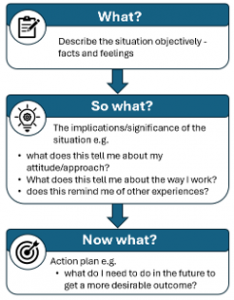
The ‘What? So what? Now what? model
Next, students submit the reflection in their own time. There is a word count requirement of 100-150 words and students are told not to use generative AI as we want their personal reflections on the situation. If the whole experience is too much to write about in 150 words, they can reflect on one aspect so they can go into greater detail. We encouraged students to use phrases like ““I felt this because…”, “This is important because…”, “The impact of this will be…”.
Finally, once the deadline is passed, we team mark all the reflections (i.e. all markers are together in the same room). This has the benefit that any queries can be addressed within the group and a consensus reached. All of the markers are familiar with using a reflective cycle in their own practice. As well as commenting on what has been done well, as this is a formative assessment, feedback focuses on improvements for the future. Only in situations where the reflection significantly deviates from what is required are students asked to submit a second attempt.
The impact (results)
Student feedback does not mention the reflection specifically but we believe it is valuable as it gives an initial introduction to a skill students will be asked to do many times in Stage 1 and beyond, and, therefore, provides a representative educational experience. It also authentically mirrors the expectations of the professionalism strand of the course which aligns with General Medical Council requirements.
Lessons learned
We have refined the taught session on reflection over the last three years based on how students performed in the assessment and addressed gaps in the information presented. Common pitfalls were that the description of the situation was too long, actions to improve were not specific enough and that descriptions were of other people’s actions rather than the student’s own. We learnt that we needed to be explicit that we expected students to write in paragraphs and that headings weren’t needed.
There appeared to be a natural desire amongst the students to want to be self-congratulatory and had to be encouraged to identify what to improve and why that was important.
Tips for colleagues
Although this was part of a supported-entry route Summer School (where the incentive is a reduced offer for passing the Summer School), these small moments of reflection could be incorporated into a taught module at UG or PGT level. Careful thought should be given to whether this could or should be credit bearing (and, if so, whether this is based solely on submission or whether the reflections will be graded). Not attaching credits may allow students to write more authentically. Attaching credits to reflection can help with engagement and acknowledges the work involved, however, many smaller pieces of summative work can increase anxiety for students, especially when they are unfamiliar with the format. Essentially, there are four ways that reflection could be used within a course: voluntary, pass/fail based on completion, formative or summative. These are summarised nicely here.
Equally, deciding on the topic of the reflection is important. It could be a single (new) experience or several moments within a longer process. It is important that colleagues giving feedback are familiar with reflection. Personal reflection is deeply personal and unconstructive feedback can have a negative impact on the student.
Colleagues may wish to consider if “reflection” is the best name for this type of assessment. For example, one of these could be more accessible: “evidence of learning”, “personal learning analysis”, “self-assessment”, “critical review of practice”.
Skills and attributes
Students were able to develop the following attributes:
Education for Life Strategy
This case study reflects the following aims of the Education for Life strategy:
- Equity: To provide a core, universal offer for all students, including tailored provision where needed, to ensure equity of access, experience and in outcomes for all, regardless of background, identity, nationality, location or mode of study.
- Fit for the future: To ensure our students are fit for their future, our teaching is fit for the future of our offer, and our colleagues are fit for the future of HE
Further resources
We used the University of Edinburgh’s Reflection Toolkit to inform the in-class material on reflection.
https://reflection.ed.ac.uk/reflectors-toolkit/reflecting-on-experience/what-so-what-now-what
We also direct students to this page to give an overview of why reflection is important and examples of questions to think about when reflecting:
https://www.ncl.ac.uk/academic-skills-kit/study-skills/independent-learning/reflective-practice/
Authors
 |
Dr Alison Graham Senior Lecturer in Medical Sciences Education School of Medicinealison.graham@ncl.ac.uk |