We designed enterprise challenges with charities to help Psychology students apply psychological literacy to real community issues, develop employability skills, and see how their subject knowledge can make a difference beyond professional psychology careers.
Our challenge / opportunity
In Psychology, one of our ongoing challenges is helping students recognise the breadth of futures their degree can open up. Across the UK, only a relatively small proportion of psychology graduates go on into professional psychological careers, such as clinical psychology. Many students still arrive with an aspiration to help people, work in caring or empathetic professions, and use psychology to make a positive difference.
That means our curriculum needs to do two things at once. It needs to support students who want to progress into professional psychology routes, while also helping all students develop transferable skills they can use in a wide range of personal, professional and societal contexts.
In Psychology we often describe this as developing psychological literacy: the ability to apply psychological knowledge and skills to real-life problems. I wanted students to experience that application in a way that felt authentic, practical and connected to the world beyond the University. The opportunity was to use enterprise learning not simply as “business” activity, but as a way of helping students see how psychology can be used creatively, ethically and realistically in response to complex social challenges.
Our solution (approach)
Working with colleagues in the Careers Service, particularly Alicia Cotterell and later Charlotte Hope, we developed a model of enterprise, creativity and innovation challenges for Psychology students.
The idea was similar in format to a Dragon’s Den-style challenge but adapted for charitable and community contexts rather than commercial profit. An external organisation would pose a real-life challenge, and students would work in groups to design a product, service or intervention that addressed it using their psychological knowledge.
The Careers Service provided the structure of the challenge and the enterprise-learning framework. Our role as educators was to make the activity psychologically meaningful: choosing the right kind of partner, framing the challenge carefully, and helping students connect their subject knowledge with the realities of working with people and organisations.
One of our first challenges involved Thirteen Group, a large Northeast charity supporting veterans of armed conflicts, including through housing provision. The charity came in to introduce its work, share materials and videos, and explain the kinds of mental health and socioeconomic needs faced by the veterans it supported. Some veterans also contributed to the session, helping students understand the human context behind the challenge.
We ran that challenge in one compact day, although the model can be adapted to a week, a semester, or a longer project. Students worked in groups through a scaffolded process. They began with a divergent phase, generating a wide range of ideas, before moving into a convergent phase where they agreed which idea to develop. They then had to think through the practicalities: costs, marketing, budget, scalability, sustainability and whether the idea could work in the real world.
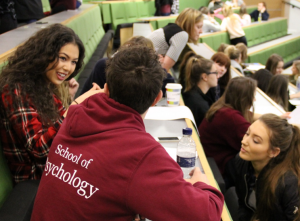
Students participating in the enterprise challenge
A key part of the process was that students had to pitch their proposal back to a panel. The panel included members of the partner charity as well as psychologists and educators, so students had to explain both the psychological rationale and the practical viability of their idea.
One winning group proposed pairing a local dog shelter with structured dog-walking sessions for veterans, drawing on evidence around the benefits of exercise, companionship and caring for another living being. They called the project “Puppies to Save the Day”, or PTSD which we thought was brilliant. The charity liked the idea so much that they invited the group for lunch, which was a nice immersive experience for the students. They adapted the proposal, and, as far as we understood afterwards, continued using it.
We continued to use the model with different charities and different challenges, including work relating to children with hearing disabilities and projects supporting young people experiencing loneliness. In each case, the core principle was the same: students were asked to bring psychology to a real problem, with real people, real constraints and real ethical considerations.
The impact (results)
The main impact for students was that the challenge made psychological literacy visible and tangible. Instead of treating theory as something that only belongs in essays, lectures or exams, students had to ask: how could something I have learned in social, cognitive, developmental or clinical psychology help an organisation address a live issue?
That shift matters. At a minimum, the challenge gives students a concrete example of how psychology can be applied beyond the classroom. It also gives them experience of teamwork, creative problem-solving, communication, pitching, enterprise thinking and engagement with an external organisation.
In the research we carried out around the activity, students reported a measurable increase in psychological literacy after taking part. There is a caveat: this was self-report data, so it tells us what students perceived about their own development. For this kind of educational aim, however, that perception is important. If students feel more able to see how psychology applies to the real world, that is a meaningful outcome.
Student feedback gathered through available mechanisms was mostly positive, although not every student immediately saw the point of the activity. Engagement was also a challenge at times, particularly when the activity involved a lot of organisation and sat alongside the usual pressures of attendance and workload. Even so, the evidence we gathered suggested a statistically significant improvement in reported psychological literacy, which was the core purpose of the intervention.
There was also impact beyond the student group. The charity example showed that students’ ideas could be useful to external partners, not just as hypothetical exercises but as proposals that organisations might adapt. For students, seeing that their work could be taken seriously by a real partner was powerful.
We are currently working with colleagues at Durham University on developing a multi-site competition between universities in the Northeast, which if successful, could be rolled out nationally. This could take the form of a longer-term project, delivered over a semester.
Another idea being discussed is a collaborative online international learning module (COIL) between universities from different countries. We recently attended a seminar conference to discuss collaborations, and we received interest from potential partners for a project to develop intercultural competence, using a variant of the enterprise challenge. Intercultural competence is an important part of psychological literacy, so this would be a fantastic way to develop the concept.
Lessons learned
One of the most important lessons is that the model is highly versatile. It can be run in a day, across a week, or over a semester. It can be delivered on a shoestring, or enhanced with funding for things like lunch, refreshments or a more developed event format. We even adapted it online during COVID.
The external partner does not always need to do a huge amount of work. Some organisations can provide materials and a challenge brief, and the activity can still run. However, the experience is much stronger when representatives from the organisation are present and able to build the context for students. That makes the challenge more exciting, more visceral and more clearly connected to real people.
Choosing the right partner and challenge is crucial. The activity needs to be relevant to the discipline, but also appropriate for the pedagogic aims and the enterprise-learning outcomes. For Psychology, charities working with mental health, wellbeing, disability, loneliness, care or social support created a natural bridge between the subject and the real-world challenge.
There are also ethical considerations. Staff need to discuss with the partner what can and cannot be disclosed, especially when charities are working with people in sensitive circumstances. Consent matters when stories, videos or personal experiences are shared. We also built ethical thinking into the student task itself: students needed to consider not only costs, benefits and budgets, but also the ethical implications of what they were proposing. For example, if students suggest an app to connect lonely young people, they need to think carefully about safeguarding, privacy and unintended consequences.
Tips for colleagues
My first tip is to speak to the Careers Service. The partnership with Careers colleagues was central to making this work. They brought the enterprise-learning structure and helped us see how it could support employability. We brought the disciplinary context and the psychological literacy agenda. The activity worked because those two perspectives came together.
Second, do not feel you have to create a large or expensive event. Start with a clear challenge, a willing partner and a structure that helps students move from ideas to a practical proposal. The model can grow over time.
Third, invest time in localising the challenge to your subject. The external organisation and the task need to make sense for your students’ discipline. When the fit is right, students can see why their subject knowledge matters.
Fourth, build a good relationship with the partner organisation. For charities, this can also be an opportunity to raise awareness among students, make connections with potential volunteers, and inspire future fundraising or engagement.
Finally, make space for reflection. We encouraged students to draw on the enterprise challenge in reflective logs and assignments linked to psychological literacy. That reflection helps students translate the experience into language they can use in future academic, professional and employability contexts.
Skills and attributes
Students were able to develop the following attributes:
- Reflective and self-aware
- Ethical awareness
- Critical thinking
- Problem solving
- Creative thinking
- Enterprising
- Communication
- Collaboration
- Leading and influencing
- Insight
- Future focused
Education for Life Strategy
This case study reflects the following aims of the Education for Life strategy:
- Encounters with the Leading Edge: To put at the heart of our curriculum and learning experiences, encounters with our world leading research and the leading edge of industry and practice.
- Fit for the future: To ensure our students are fit for their future, our teaching is fit for the future of our offer, and our colleagues are fit for the future of HE
Further resources
- You can read more about enterprise challenges and how we used them in our paper: Rosenkranz, P., Cotterell, A., Fielden, A., Hope, C., James, T. and Moffat-Knox, B. (2024). Not Exactly Dragon’s Den: Enterprise Challenges can Enhance Psychological Literacy. Psychology Learning and Teaching, 23(2), 281–297.
- Careers Service
Authors
 |
Dr Patrick Rosenkranz Degree Programme Director (Joint Honours) School of Psychology patrick.rosenkranz@newcastle.ac.uk |