A Postgraduate engineering project where mixed-discipline teams collaborate over a year on a design task. Assessment covers both output and teamwork, with structured feedback, peer review, and individual contributions shaping final marks and skill development.
Our challenge / opportunity
This case study describes a group project in postgraduate engineering that draws together students from across engineering disciplines into working teams for a group assessment. Students must each draw on their area of expertise with allocated inputs.
Stated module aims and objectives are:
- Working as a member of a team, to jointly develop and manage a design or research project, to present its findings, and to produce a team project report.
- To develop competence and skills in: Team management; time and task management; research and information retrieval; oral and written presentation; interpersonal skills.
A particular challenge with this project is that we assess the process of team work as well as the product produced by each group.
Our solution (approach)
The teams are formed by the teaching staff to ensure a mix of demographic features such as gender and nationality, a balance in the range of disciplines presented in the cohort, and an approximately equal average of Stage 3 grade outcomes (a mix of students holding grades of 1st, 2:1, and 2:2).
The project runs over the course of a full year, starting with a period where the students select a topic and define a design problem for their chosen context. We suggest that the groups initially come up with a few different ideas and then work together on the best one. This culminates in a project pitch presentation to academics and representatives from industry, where students can gain some feedback on their plans. As well as this initial presentation after six weeks, there are further formative assessment opportunities where the teams can gain feedback on their projects at fifteen and twenty-six weeks through the project.
Throughout the project, the groups are expected to hold formal team meetings to plan and allocate tasks, discuss their progress, and identify what actions need to be taken to keep the group on track, including recording when members of the team are not performing to expectations. Each group elects a Chair and Secretary who take these roles for their meetings throughout the project, and the team is expected to report progress to the academic team, which should be done by inviting one of them to attend a meeting, and providing a written report when appropriate. The individuals in the team are also expected to keep logs of their individual work on the project, which are submitted along with the summative assessed elements, and used to moderate individual marks.
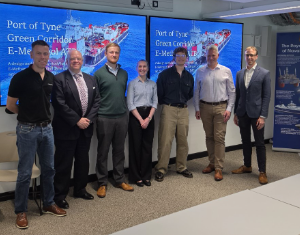
Students from one of the project teams alongside industry representatives
There are three summative elements, which are all submitted at the end of the design process. The team collectively write two linked Project Reports:
- One technical report detailing the design and problem-solving aspects of the project, with an overall limit of two-hundred pages. Students will be responsible for writing specific sections of this report, in line with their specific discipline within engineering. These individual chapters generate an individual mark, and are assessed by a marker from the same specialism.
- A Critical Review which is written in a sixteen-page provided template document. This outlines a summary of the design, a review of design aspects, and an in-depth critical review of the success of the design.
The second element is a Group Presentation and Poster, presented at the end of Semester 2. Creativity is encouraged to allow for students to use multimedia.
The final element is a Team Organisation Report, outlining the input of each individual, reporting on the organisation and effectiveness of the team as a whole, and including documents such as project schedules, meeting minutes, peer reviews, and individual logbooks.
The individual work in the Technical Report, peer reviews, and formative assessment points (including academic attendance at team meetings) provides a robust structure to ensure that individual marks are allocated fairly. A group mark is decided overall, and then adjusted based on the input of each individual.
The impact (results)
Students are generally positive about this approach, enjoying the project, but also viewing the grading process as fair, with some marks allocated based on contributions to the team. Moreover, students are able to develop valuable skills through working together, particularly in communication and collaboration, which they are then able to cite as experience when it comes to job applications.
Lessons learned
We had previously grouped students differently, particularly in grouping together students with similar grades or degree classifications. We found that this did not work as effectively, and lost many of the benefits of peer learning and working, and working collaboratively.
Tips for colleagues
Our peer review process is in two stages: firstly, the teams agree a set of grades together, following the question ‘assuming that your group average mark is 70, what should each member of the team score, based upon their input into the group?’ Scores 70 across the board are not accepted, and teams have to properly negotiate and identify where the workload has fallen.
This is followed with each individual member submitting individual grades based on their own feelings, with a brief justification for why certain team members may have scored higher or lower (based on things like input and attendance). We have found that this process allows students to bring some honesty outside of the group submission. These moderating marks are used, along with other evidence from meeting minutes, tutorials, and tutor observation, to adjust marks for individuals from the group score.
Skills and attributes
Students were able to develop the following attributes:
- Reflective and self-aware
- Critical thinking
- Problem solving
- Creative thinking
- Communication
- Collaboration
- Future focused
Education for Life Strategy
This case study reflects the following aims of the Education for Life strategy:
- Equity: To provide a core, universal offer for all students, including tailored provision where needed, to ensure equity of access, experience and in outcomes for all, regardless of background, identity, nationality, location or mode of study.
- Encounters with the Leading Edge: To put at the heart of our curriculum and learning experiences, encounters with our world leading research and the leading edge of industry and practice.
- Fit for the future: To ensure our students are fit for their future, our teaching is fit for the future of our offer, and our colleagues are fit for the future of HE