
Using peer assessment to ensure fairness in group projects.
Our opportunity
The group assessments described below give students a rich opportunity to work together, gain vital teamwork experience, and build skills that can be difficult to gain through individual work and assessment.
This is not without challenges: there are academic integrity questions in confirming who has contributed to the group activities and produced the actual work, for instance. While each module assessment contains elements that can be completed individually, there is still a significant proportion of each module’s weighting that relies on collaborative teamworking, problem based, and experiential learning.
Our approach
Fiona Thompson leads two modules at Newcastle University Business School’s (NUBS) Marketing programmes that have assessed group projects.
For Integrated and Digital Marketing Communications (MKT2010), students work in groups with a Live Client to develop a Marketing Communications Plan. The assessed elements for this project are a collaboratively written report and an infographic poster presentation to the client themselves. This group project is worth 50% of the overall 20-credit module grade and has students from two different Marketing degree programmes who take it (one compulsory, one elective). Students self-select their MKT2010 teams from those in the Seminar and there is one Live Client per Seminars (4/5 Live Clients in total depending on student numbers).
One of the capstone module options for undergraduate Marketing students is to take a Marketing Consultancy Project (MKT3097) which is open to both Marketing degrees. The summative assessment contains three elements: a group Live Client Marketing Consultancy Report (40%), a group oral presentation (10%), and an individual Reflective Essay (50%). Students form friendship groups of 4 students; two friendship groups are randomly combined to make a Project Team of up to 8 students. This third-year capstone module instead of a dissertation allows students to experience first-hand problem-based learning, collaborative learning, experiential learning and reflective learning which are all elements of the Leading-Edge Curriculum.
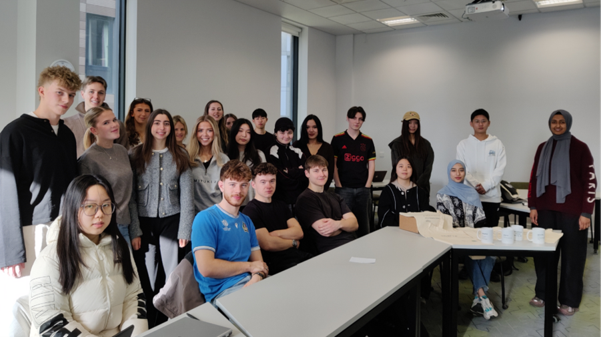
Stage 2 Marketing students with representatives of West End Women and Girls Centre
Gill Holden leads a Stage 2 Accounting and Finance module, Understanding Company Accounts (ACC2021), which includes 80% of its assessment as the outputs of a group project: a report (60%) and accompanying presentation (20%) about a public listed company. The students take on the role of a team of graduate trainees in a professional services firm and work together over several months. Each student also submits an individual multimedia journal of their experience using Microsoft Sway, which is the final 20% of the module marks. The students on this module self-select their groups based upon the company that they will be investigating.
As well as individual assessment elements, these modules also all use Buddycheck for peer group assessment (PGA). This gives students the opportunity to ‘rate’ one another on a scale of 1-5 based on their personal contributions across different teamworking dimensions of: timeliness of input; quality of work; communication; and attendance. These peer scores are used to distribute the overall group mark into individual marks. It provides fairness and allocates less marks to those who contributed less. The system works on averages, comparing the overall group average to the individual ‘received’ average.
Students in all three modules were all given a practice Buddycheck version as a part of a formative assessment earlier in the module to show the effect of PGA on their possible grades. This helped to underline the importance of contributing equally to the group’s work and helped carry the module’s mantra of ‘no work = no marks!’.
“If students were in a commercial work environment and they did not complete any work at all, it might be: ‘here’s your P45, there’s the door and goodbye’! At university we need to develop the workplace ethos that it is not OK to social loaf or expect somebody else to do your work for you. We need to instil into students the importance of taking ownership, continual development of skills, flexibility, understanding consequences which will help prepare them for the future changing workplace.”
Fiona Thompson – Module Leader of MKT2010 and MKT3097
The impact (results)
The quality of the work produced by the groups across these modules shows that this collaborative group working using an experiential learning approach works extremely well. Students were able to gain valuable lifelong (hard and soft) skills. This was also reflected in the students’ individual Reflective Essay elements on MKT3097. These showed that students had gained rich experiences in working collaboratively.
Students were able to show growth across a broad range of employability and Graduate Framework skills. Students were able to use these experiences into job applications, LinkedIn profiles and interviews for work internships and graduate employment to great success. The employability skills gained through collaboration, leadership, problem-solving and shared experiences were extremely valuable and will stay with students for the rest of their lives.
Lessons learned
A single assessment or exam cannot replicate the wide range of employability skills that students develop by working in teams or groups. By allowing some friendship groups to be created within each group, this helps create engagement and motivation from the start.
By using the People function on Canvas you can set up self-selecting friendship groups for students to add themselves into. If you are working with Live Clients, having a clear written brief from them helps get everyone (students and staff) on the ‘same page’ about their specific project. This brief is just a set of questions in a Word document sent out to each Live Client for them to complete and return. Questions such as where you are now, what are the issues, what can our students help with etc.
This ensures you receive consistent coverage in a physical electronic reference document. Organising meetings with Live Clients well in advance also helps to ensure engagement from everyone involved. By having a Team Leader of each project group/team this creates a single point of contact for the Live Client/Teaching Team and helps replicates real working life. By having regular communication updates sprinkled throughout the project helps create trust and confidence especially if the project is across two Semesters as in MKT3097.
Tips for colleagues
- Have a clear plan and idea over what your students are capable of or can help with.
- Be prepared to the scope the ‘shopping list’ of items provided on the Client Brief into a doable project with the agreement of the Live Client. Do not be afraid to say ‘No’ we cannot help with that part of the project but can help with this part.
- Always – plan, action, review, and reflect each year as this builds in continual improvements year on year.
- Students often forget experiences, especially if the project is over two semesters like MKT3097, so build in support early in the module for students to record reflections for their individual elements.
- Using a model (such as Gibbs’ Reflective Cycle, for example) and reflection and ePortfolio tools can be helpful to record experiences that can be reflected on later in the MKT3097 Reflective Essay assessment.
Skills and attributes
Students were able to develop the following attributes:
- Reflective and self-aware
- Self-management
- Self-directed learning
- Ethical awareness
- Flexibility and resilience
- Critical thinking
- Problem solving
- Creative thinking
- Digital skills
- Enterprising
- Communication
- Collaboration
- Leading and influencing
- Insight
- Future focused
Education for Life Strategy
This case study reflects the following aims of the Education for Life strategy:
- Encounters with the Leading Edge: To put at the heart of our curriculum and learning experiences, encounters with our world leading research and the leading edge of industry and practice.
- Fit for the future: To ensure our students are fit for their future, our teaching is fit for the future of our offer, and our colleagues are fit for the future of HE
Further resources
Authors
 |
Gill Holden Senior Lecturer in Accounting Newcastle University Business School gill.holden@newcastle.ac.uk |
 |
Fiona Thompson Senior Lecturer Newcastle University Business School fiona.thompson2@newcastle.ac.uk |